
When A Safety Boundary Still Looks Governed
A diagnostic condition emerged in an oil and gas environment where a visible review path remained intact while the authority conditions supporting the safety boundary had already narrowed.
The reviewed environment preserved a structured operational surface. Detection occurred. The alert entered a recorded review path. Oversight remained visible. Work continued. The deeper issue concerned whether the authority conditions behind that sequence still preserved meaningful control at the point where interruption should have mattered. The process still looked monitored, documented, and controlled, even though the alert had been routed into a review path built for acknowledgment rather than active hold authority.
Institutional Setting
The reviewed setting was a live oil and gas operating environment in which an automated vision safety monitoring system watched a restricted work zone during active operations. The monitored area sat close to ongoing field activity and formed part of the control structure around continued work in that zone. The workflow still appeared structured and intact at the surface. Detection generated an alert, the event moved into a recorded review path, and oversight remained visible in the process while field activity continued.
This was not an environment with a weak visible record. Several conditions remained present at the level of operational form:
- Automated Detection At The Boundary
- A Recorded Alert Path
- Visible Oversight Inside The Workflow
- Continued Field Activity In A Live Zone
- A Monitored And Documented Operating Surface
Those conditions made the environment appear governed. The institutional question sat deeper. The review had to determine whether the authority available at the safety boundary still retained meaningful power to interrupt or redirect work once the boundary had already been reached.
Diagnostic Trigger
The review followed a near miss elsewhere in the operating environment and formed part of a broader examination of how critical safety alerts were handled in monitored work zones.
That trigger matters because it shifted attention away from whether the alert had been seen and toward what authority the workflow still preserved after detection. In environments of this kind, a recorded alert and visible oversight can create the appearance of preserved control. The deeper question is whether the process still holds active authority where the boundary is encountered, or whether control has already been displaced into actions outside the core step shown in the record.
The review was therefore commissioned to examine the structural condition of the authority environment at the safety boundary rather than the alert record alone.
Review Findings
The review found that the alert had routed to a queue built for acknowledgment rather than active hold authority. The review step preserved visibility, but it did not place immediate stop authority inside the same point in the process. Oversight could acknowledge the event while interruption or escalation depended on action outside the core step shown in the record. Work therefore continued inside a workflow that still looked governed, even though the authority available at the safety boundary had narrowed more than the process suggested.
Several conditions remained visibly intact:
- Detection Had Occurred
- The Event Had Been Recorded
- Oversight Remained Visible In The Process
- The Workflow Still Carried The Appearance Of Control
What had weakened was not visibility. What had weakened was the authority retained inside the boundary itself. The process preserved acknowledgment. It preserved a less certain account of who or what still held meaningful control over continuation at the moment where interruption should still have mattered.
This is why the finding is structural. The environment still looked governed in the record. The authority condition inside that visible workflow had become thinner than the process itself implied.
Institutional Reading
This case presents a safety boundary that remained legible in the workflow after the authority inside it had weakened enough to carry less control over continuation. The absence of detection was not the problem, but rather, the displacement of active hold authority away from the point in the process where the boundary was encountered.
In live operating environments, that kind of condition can remain hidden beneath a persuasive operational surface. Detection is visible. The event is recorded. Oversight remains present. The environment therefore continues to present itself as monitored and controlled. Later examination becomes more difficult because the visible workflow preserves the appearance of governance while preserving a weaker account of whether meaningful interruption authority still existed inside the boundary when operations continued.
This is the institutional reading of the case. The workflow still looked governed. The authority environment inside it no longer carried the same degree of control that the visible process suggested.
Why It Matters
The condition becomes more serious when attention shifts from the alert itself to the authority environment that existed when operations continued. The institution may still be able to show that detection occurred, that the event was recorded, and that oversight remained visible in the process. The harder question concerns whether oversight still retained meaningful authority to interrupt or redirect work once the boundary had already been reached.
This matters for several reasons:
- Visible Oversight Can Outlast Meaningful Control
- Recorded Acknowledgment Does Not Equal Active Hold Authority
- Boundary Governance Depends On More Than Detection and Review
- Later Explanation Becomes Harder When Continuation Was Still Possible Inside A Narrowed Authority Condition
In a live oil and gas environment, that distinction carries operational and institutional weight. A process may continue to look disciplined while preserving a less dependable account of whether the boundary still retained effective control over continuation.
EIAA Insight
The case reflects a condition where visible safety review remained intact while the authority basis supporting the boundary became less coherent across time.
The review remained visible. The preserved authority force behind the boundary did not remain equally intact.
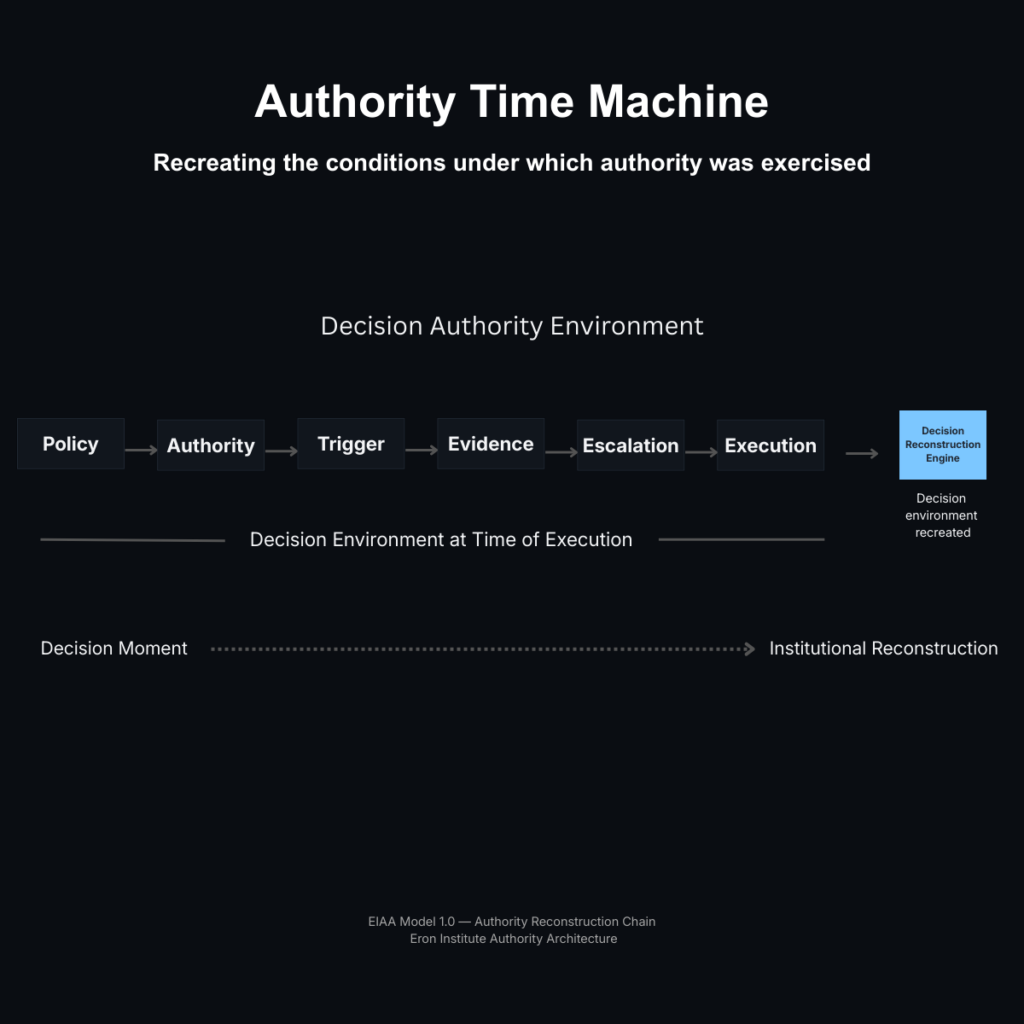
Authority Time Machine
A central concern in this review was whether the institution still preserved enough continuity to reconstruct the authority environment surrounding the restricted work zone alert at the moment operations continued.
The Authority Time Machine provides the right lens for this kind of environment because the issue is not simply whether an alert existed. The issue is whether the surrounding decision environment still preserved a coherent account of control at the boundary. In this case, the reconstruction would examine:
- Policy
- Authority Assignment
- Trigger Conditions
- Evidence
- Escalation
- Execution Context
The purpose is to determine whether the visible workflow still rested on a preserved authority environment or whether later explanation had become too dependent on reconstruction because acknowledgment had remained visible while active hold authority had narrowed at the point where it still needed to matter.
Institutional Diagnostic
If a safety boundary remains visible while the authority conditions behind it cannot be reconstructed, exposure may already be embedded in the process.
Case Record Context
Case Type
Diagnostic Case Record
Institutional Environment
Live Oil And Gas Operating Environment
Primary Diagnostic Issue
Authority Drift At The Safety Boundary
Analytical Lens
Preserved Authority Across Time
Framework
Eron Institute Authority Architecture
Related Capability
Authority Time Machine